


Dominique Perrin
Thomas H. Cormen, Charles E. Leiserson, Ronald L. Rivest, Algorithms, MIT Press, 1990.
Donald E. Knuth, The Art of Computer programming, vol. 1: Fundamental Algorithms, vol. 2: Seminumerical Algorithms, vol. 3: Sorting and Searching, Addison Wesley, 1973.
Jan van Leeuwen,Handbook of Theoretical Computer Science, vols. A et B,
Elsevier, 1990.
Robert Sedgewick, Algorithms in C, Addison Wesley, 1991.
Ken Arnold, James Gosling, The Java programming Language, Addison Wesley, 1997.
David Flanagan,
Java Examples in a Nutshell,
O'Reilly, 1997.
Patrick Niemeyer, Joshua Peck,
Exploring Java,
O'Reilly, 1997.
Thomas A. Standish, Data Structures in Java, Addison Wesley, 1997.
class Bonjour {
  public static void main(String[] args) {
    System.out.println("Bonjour");
  }
}
Pour le compiler:
javac Bonjour.javaet pour l'exécuter :
java Bonjour
class Num {
  static int factorielle (int x) {
    int f = 1;
    for (int i= 2; i <= x; i++)
      f = f* i;
    return f;
  }

  public static void main(String[] args) {
    int n = Integer.parseInt(args[0]);
    System.out.println(factorielle(n));
  }
}
la fonction factorielle peut aussi s'écrire :
  static int factorielle (int x) {
    if (x <= 0) return 1;
    else return x * factorielle(x-1);
  }

static int pgcd (int m, int n) {
  if (n == 0) return m;
  else return pgcd( n, m % n);
}
ou encore, sans appel récursif
static int pgcd(int m, int n) {
  int r;
  while (n != 0) {
    r= m % n; m= n; n= r;
  }
  return m;
}
class Num {
  static int pgcd(int m, int n) {
    if (n == 0) return m;
    else return pgcd(n, m % n);
  }
  public static void main(String[] args) {
    int a,b;
    a= Integer.parseInt(args[0]);
    b= Integer.parseInt(args[1]);
    System.out.println(pgcd(a,b));
  }
}
Exécution :
>javac Num.java
>java Num 8 13
1
>
static int[] pgcd2(int m, int n) {
  int a[]=new int[3];
  if (n == 0) {
    a[0]=m; a[1]=1; a[2]=0;
  } else {
    int temp;
    a= pgcd2(n, m % n);
    temp= a[2]; a[2]= a[1]- a[2]*(m/n);
    a[1]= temp;
  }
  return a;
}
De fait, si
u'n+v'r=p, on aura
class Complexe {
  double x, y;
  Complexe( double re, double im) {
    x= re; y= im;
  }
  double valeurAbsolue() {
    return Math.sqrt(x*x + y*y);
  }
  static Complexe
          somme(Complexe c, Complexe d) {
    return new Complexe(c.x + d.x, c.y + d.y);
  }
  static Complexe
         inverse( Complexe c) {
    double r=c.x*c.x + c.y*c*y;
    return new Complexe( c.x/r, -c.y/r);
  }
  String toString() {
     return x + " + " + y + "i";
  }
  static Complexe
        produit(Complexe c, Complexe d) {
    return
     new Complexe( c.x*d.x - c.y*d.y,
                   c.y*d.x+ c.y*d.x);
  }
  public static main (String[] args) {
    Complexe c d;
    c = new Complexe(1,2);
    System.out.println(somme(c,c));
    d= inverse(c);
    System.out.println(produit(c*d));
  }
}
Exécution :
2.0 + 4.0 i
1.0 + 0.0 i
 est une suite
 d'entiers naturels
telle que:
d'entiers naturels
telle que:
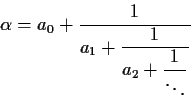 est un nombre rationnel m/n,
la suite des quotients
obtenus en appliquant l'algorithme d'Euclide à (m,n) est un développement
en fraction continue de .
est un nombre rationnel m/n,
la suite des quotients
obtenus en appliquant l'algorithme d'Euclide à (m,n) est un développement
en fraction continue de .
En effet si m=qn+r, on a
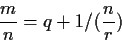
On en déduit la méthode suivante, qui affiche les termes successifs du développement :
static void cont(int m, int n) {
  if (n != 0) {
    System.out.println( m / n);
    cont( n, m % n);
  }
}
Pour le développement d'un nombre réel , on aura :
static void cont(double alpha, int n) {
  int a,i;

  for (i = 0; i< n; i++) {
    a =  alpha;
    System.out.println(a);
    alpha = 1/(alpha-a);
  }
}
Le résultat de l'appel de cont(3.14159,4) est
3
7
15
1
.
class FracContinue {
  int terme;
  FracContinue reste= null;

  FracContinue(double alpha, int n) {
    terme= (int) alpha;
    if (n > 0)
      suite=
       new FracContinue(1/(alpha-terme), n-1);
  }
  public  String toString() {
    String s= terme+ " ";
    if (reste != null)
      s= s + reste.toString();
  }
}
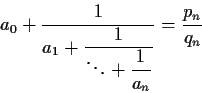

 , on a

![\begin{displaymath}{\frac {312689}{99532}},{\frac {833719}{265381}},{\frac {
1146408}{364913}},{\frac {4272943}{1360120}}]\end{displaymath}](img10.gif)
On peut aussi calculer les continuants récursivement :
  int[] Continuant() {
   // calcul des  continuants
    int[] a= new int[2];
    if (this.reste == null) {
      a[0]=this.terme;
      a[1]=1;
    }
    else {
      int[] b= this.reste.Continuant();
      a[0]=this.terme*b[0] + b[1];
      a[1]= b[0];
    }
    return a;
  }
L'éxecution de
FracContinue s= new FracContinue(Math.PI,4);
int a= s.Continuant();
System.out.println(a[0]+"/"+a[1]);
donne
103993/33102